
WEDNESDAY OF THE THIRD WEEK OF LENT
[Commemoration]
SIMPLE / PURPLE
The clear commandments of God are the light of hope for all the world; they are the eternal will, the eternal law of God that keeps everyone and everything in order and in peace. Obedience to God, and to His authority delegated to men, is the first duty of justice and the beginning of wisdom. Disobedience is injustice, shortsightedness, foolishness. Without a vivid sense of God's rightful sovereignty over everything and every detail of life, there can be no sense of sin and no sorrow for sin.
INTROIT (Ps. 30:7-8)
I will hope in the Lord. I shall rejoice and be glad because of Your mercy, for You have regarded my humility.
Ps. 30:2. In You, O Lord, have I hoped.Let me never be put to shame. In Your justice rescue me and set me free. V. Glory be . . .
COLLECT
O Lord, may our fasting and our avoidance of sin win for us Your readier forgiveness. Through Our Lord . . .
LESSON (Ex. 20:12-24)
Thus says the Lord God: "Honour thy father and thy mother, that thou mayst be long-lived upon the land which the Lord thy God will give thee. Thou shalt not kill. Thou shalt not commit adultery. Thou shalt not steal. Thou shalt not bear false witness against thy neighbour. Thou shalt not covet thy neighbour's house; neither shalt thou desire his wife, nor his servant, nor his handmaid, nor his ox, nor his ass, nor any thing that is his."
And all the people saw the voices and the flames, and the sound of the trumpet, and the mount smoking; and being terrified and struck with fear, they stood afar off, Saying to Moses: "Speak thou to us, and we will hear: let not the Lord speak to us, lest we die."
And Moses said to the people: "Fear not; for God is come to prove you, and that the dread of him might be in you, and you should not sin."
And the people stood afar off. But Moses went to the dark cloud wherein God was. And the Lord said to Moses: "Thus shalt thou say to the children of Israel: You have seen that I have spoken to you from heaven. You shall not make gods of silver, nor shall you make to yourselves gods of gold. You shall make an altar of earth unto me, and you shall offer upon it your holocausts and peace offerings, your sheep and oxen, in every place where the memory of my name shall be."
GRADUAL (Ps. 6:3-4)
Have pity on me, O Lord, for I am weak; heal me, O Lord. V. For my body is in terror, and my soul. too, is utterly terrified.
TRACT (Ps. 102:10; 78:8-9)
O Lord, repay us not according to the sins we have committed, nor according to our iniquities.
V. O Lord, remember not our iniquities of the past, let Your mercy come quickly to us, for we are being brought very low. (All Kneel.)
V. Help us, O God our Savior, and for the glory of Your name, O Lord, deliver us; and pardon us our sins for Your name's sake.
GOSPEL (Matt. 15:1-20)
At that time, then came to him from Jerusalem scribes and Pharisees, saying: "Why do thy disciples transgress the tradition of the ancients? For they wash not their hands when they eat bread." But he answering, said to them: "Why do you also transgress the commandment of God for your tradition? For God said: 'Honour thy father and mother': And: 'He that shall curse father or mother, let him die the death.' But you say: 'Whosoever shall say to father or mother, "The gift whatsoever proceedeth from me, shall profit thee." And he shall not honour his father or his mother': and you have made void the commandment of God for your tradition. Hypocrites, well hath Isaias prophesied of you, saying: 'This people honoureth me with their lips: but their heart is far from me. And in vain do they worship me, teaching doctrines and commandments of men.' "
And having called together the multitudes unto him, he said to them: "Hear ye and understand. Not that which goeth into the mouth defileth a man: but what cometh out of the mouth, this defileth a man."
Then came his disciples, and said to him: "Dost thou know that the Pharisees, when they heard this word, were scandalized?" But he answering, said: "Every plant which my heavenly Father hath not planted, shall be rooted up. Let them alone: they are blind, and leaders of the blind. And if the blind lead the blind, both fall into the pit."
And Peter answering, said to him: "Expound to us this parable." But he said: "Are you also yet without understanding? Do you not understand, that whatsoever entereth into the mouth, goeth into the belly, and is cast out into the privy? But the things which proceed out of the mouth, come forth from the heart, and those things defile a man. For from the heart come forth evil thoughts, murders, adulteries, fornications, thefts, false testimonies, blasphemies. These are the things that defile a man. But to eat with unwashed hands doth not defile a man."
OFFERTORY ANTIPHON (Ps. 108:21)
O Lord, be merciful to me for Your name's sake, because Your mercy is sweet.
SECRET
O Lord, accept the prayers and sacrifice Your people offer You. May we who celebrate Your sacred rites be guarded from all danger. Through our Lord . . .
COMMUNION ANTIPHON (Ps. 15:11)
You have made known to me the path of life; You shall fill me with the joy of Your presence, O Lord.
POSTCOMMUNION
O Lord, may the heavenly banquet of which we have partaken sanctify us, free us of all error, and make us worthy of Your promise of heaven. Through Our Lord . . .
PRAYER OVER THE PEOPLE
O Almighty God, may we who seek the help of Your protection be delivered from all evil, to serve You with untroubled minds. Through Our Lord . . .
St. Eulogius
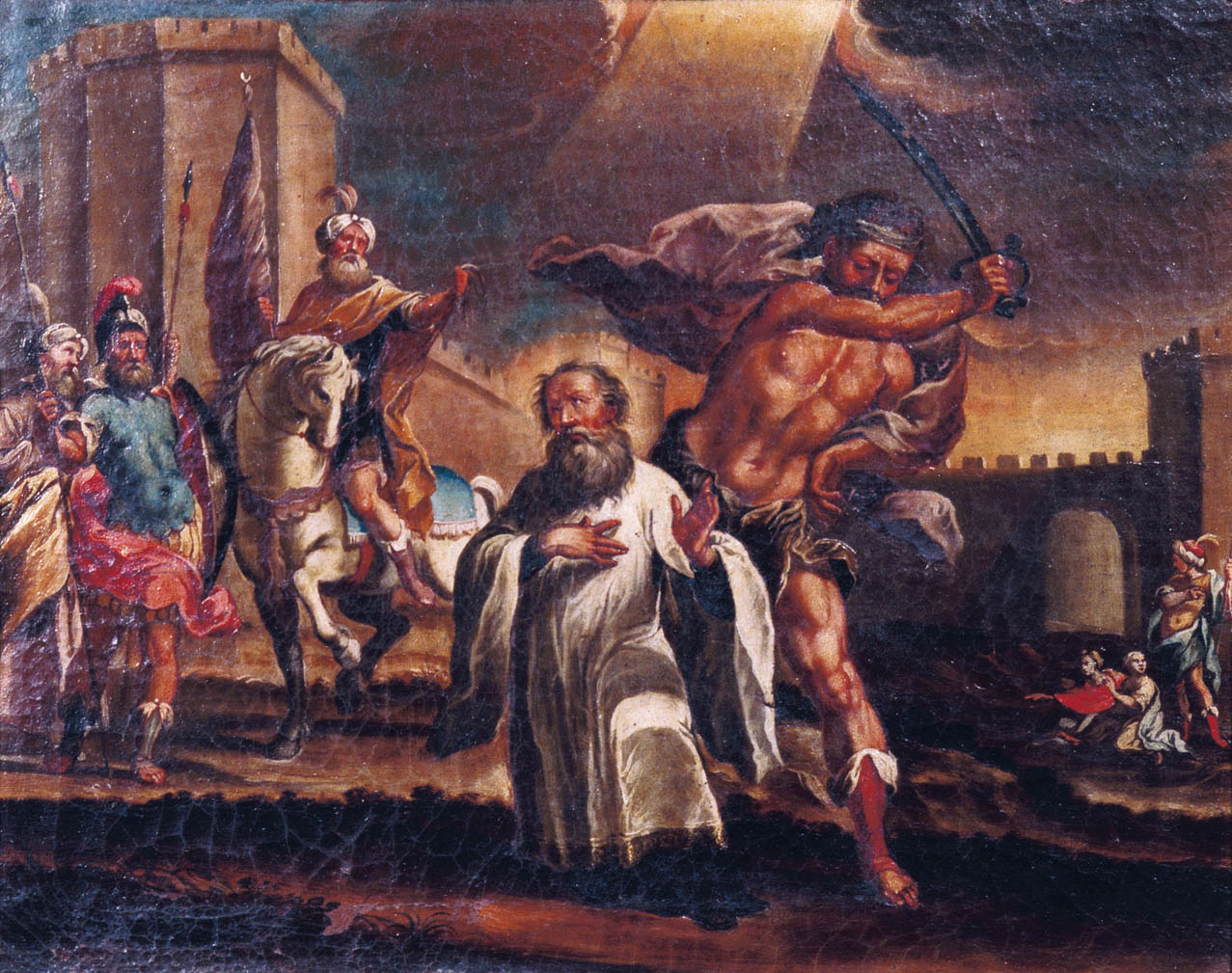
Spanish martyr and writer who flourished during the reigns of the Cordovan Caliphs, Abd-er-Rahman II and Mohammed I (822-886). It is not certain on what date or in what year of the ninth century he was born; it must have been previous to 819, because in 848 he was a priest highly esteemed among the Christians of Catalonia and Navarre, and priesthood was then conferred only on men thirty years of age. The family of the saint was of the nobility and held land in Cordova from Roman times. The Mussulman rulers of Spain, at the beginning of the eighth century, tolerated the creed of the Christians and left them, with some restrictions, their civil rule, ecclesiastical hierarchy, monasteries, and property, but made them feel the burden of subjection in the shape of pecuniary exactions and military service. In the large cities like Toledo and Cordova, the civil rule of the Christians did not differ from that of the Visigothic epoch. The government was exercised by the comes (count), president of the council of senators, among whom we meet a similarly named ancestor of Eulogius. The saint, like his five brothers, received an excellent education in accord with his good birth and under the guardianship of his mother Isabel. The youngest of the brothers, Joseph, held a high office in the palace of Abd-er-Rahman II; two other brothers, Alvarus and Isidore, were merchants and traded on a large scale as far as Central Europe. Of his sisters, Niola and Anulona, the first remained with her mother; the second was educated from infancy in a monastery where she later became a nun.
After completing his studies in the monastery of St. Zoilus, Eulogius continued to live with his family the better to care for his mother; also, perhaps, to study with famous masters, one of whom was Abbot Speraindeo, an illustrious writer of that time. In the meantime he found a friend in the celebrated Alvarus Paulus, a fellow-student, and they cultivated together all branches of science, sacred and profane, within their reach. Their correspondence in prose and verse filled volumes; later they agreed to destroy it as too exuberant and lacking in polish. Alvarus married, but Eulogius preferred the ecclesiastical career, and was finally ordained a priest by Bishop Recared of Cordova. Alvarus has left us a portrait of his friend: "Devoted", he says, "from his infancy to the Scriptures, and growing daily in the practice of virtue, he quickly reached perfection, surpassed in knowledge all his contemporaries, and became the teacher even of his masters. Mature in intelligence, though in body a child, he excelled them all in science even more than they surpassed him in years. Fair in feature [clarus vultu], honest and honourable, he shone by his eloquence, and yet more by his works. What books escaped his avidity for reading? What works of Catholic writers, of heretics and Gentiles, chiefly philosophers? Poets, historians, rare writings, all kinds of books, especially sacred hymns, in the composition of which he was a master, were read and digested by him; his humility was none the less remarkable and he readily yielded to the judgment of others less learned than himself." This humility shone particularly on two occasions. In his youth he had decided to make a foot pilgrimage to Rome; notwithstanding his great fervour and his devotion to the sepulchre of the Prince of the Apostles (a notable proof of the union of the Mozarabic Church with the Holy See), he gave up his project, yielding to the advice of prudent friends. Again, during the Saracenic persecution, in 850, after reading a passage of the works of St. Epiphanius he decided to refrain for a time from saying Mass that he might better defend the cause of the martyrs; however, at the request of his bishop, Saul of Cordova, he put aside his scruples. His extant writings are proof that Alvarus did not exaggerate. They give an account of what is most important from 848 to 859 in Spanish Christianity, both without and within the Mussulman dominions, especially of the lives of the martyrs who suffered during the Saracenic persecution, quorum para ipse magna fuit. He was elected Archbishop of Toledo shortly before he was beheaded (11 March, 859). He left a perfect account of the orthodox doctrine which he defended, the intellectual culture which he propagated, the imprisonment and sufferings which he endured; in a word, his writings show that he followed to the letter the exhortation of St. Paul: Imitatores mei estote sicut et ego Christi. He is buried in the cathedral of Oviedo.
(Taken from Catholic Encyclopedia)


No comments:
Post a Comment
Please no anonymous comments. I require at least some way for people to address each other personally and courteously. Having some name or handle helps.
Note: Only a member of this blog may post a comment.