From https://www.ncregister.com/
COMMENTARY: Finding Light in the Traditional Requiem Mass
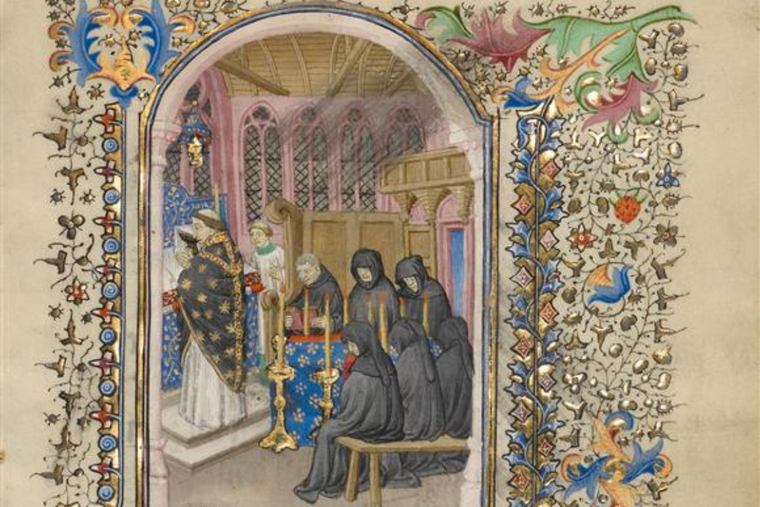
When I was in seminary back in the mid-1980s, I was informed by some of my seminary teachers that the old funeral (requiem) Masses were a very dark affair. Black vestments and somber prayers, all focused on judgment, were supposedly an “extreme” that had to give way to a newer, brighter and hopeful funeral liturgy. While I had little or no memory of the older funeral rites from before 1965, I was dubious that the old requiem Mass could have been that bad.
Immediately after my ordination in 1989, I was permitted by my bishop to say the traditional Latin Mass under the Indult of 1987. We had several locations in the diocese, and I both knew Latin and could sing. Hence, very early on in my priesthood, I began to experience and celebrate the traditional Latin Mass, including the requiem. And I must say, I found the requiem Mass anything but dark.
Further, I began to understand why the prayers of the requiem were such an inspiration to hundreds of musical composers. Some of the most glorious musical moments in Western culture have been settings of the texts from the requiem:
- There is, in the musical setting of the introit (entrance antiphon), the somber but stately and march-like Requiem Aeternum of Mozart’s Requiem.
- The beautiful setting of the same text by Gabriel Fauré has somber notes of the beginning that give way to a beautifully gentle request that the Lord give rest to the departed; it is almost a lullaby sung for the dead.
- One of the finest modern settings of the introit is by John Rutter, where dissonant and dark notes speak to the sorrow and confusion of death only to give way to a melodious, gentle and hopeful request that God give rest and bestow mercy. It is a kind of dialogue between sorrow and joyful hope, and hope wins.
- Then there are the stirring renditions of the sequence hymn of the requiem, Dies Irae (Day of Wrath) by Mozart, and Verdi, both of which depict a kind of cosmic war between life and death, righteousness and sin. It is a kind of musical onomatopoeia.
- And who can ever forget one of the great moments in cinematic history, when, in the movie Amadeus, Mozart composes the Confutatis Maledictis (a phrase from the Dies Irae)? Here, too, there is a dialogue between the fearsome rejection by the wicked of God and the plaintive request of the faithful to be called to Christ’s side. It is one of the great moments of cinematic and musical history.
- And lest we highlight only the darker syllables of the Dies Irae, one of the most tender and consoling inspirations is in the ending verses, the Pie Jesu (“Loving Jesus”). In modern times the Pie Jesu of Andrew Lloyd Webber is most well-known. But so many other wonderful compositions abound, such as Fauré’s, Rutter’s, and Cristóbal de Morales’.
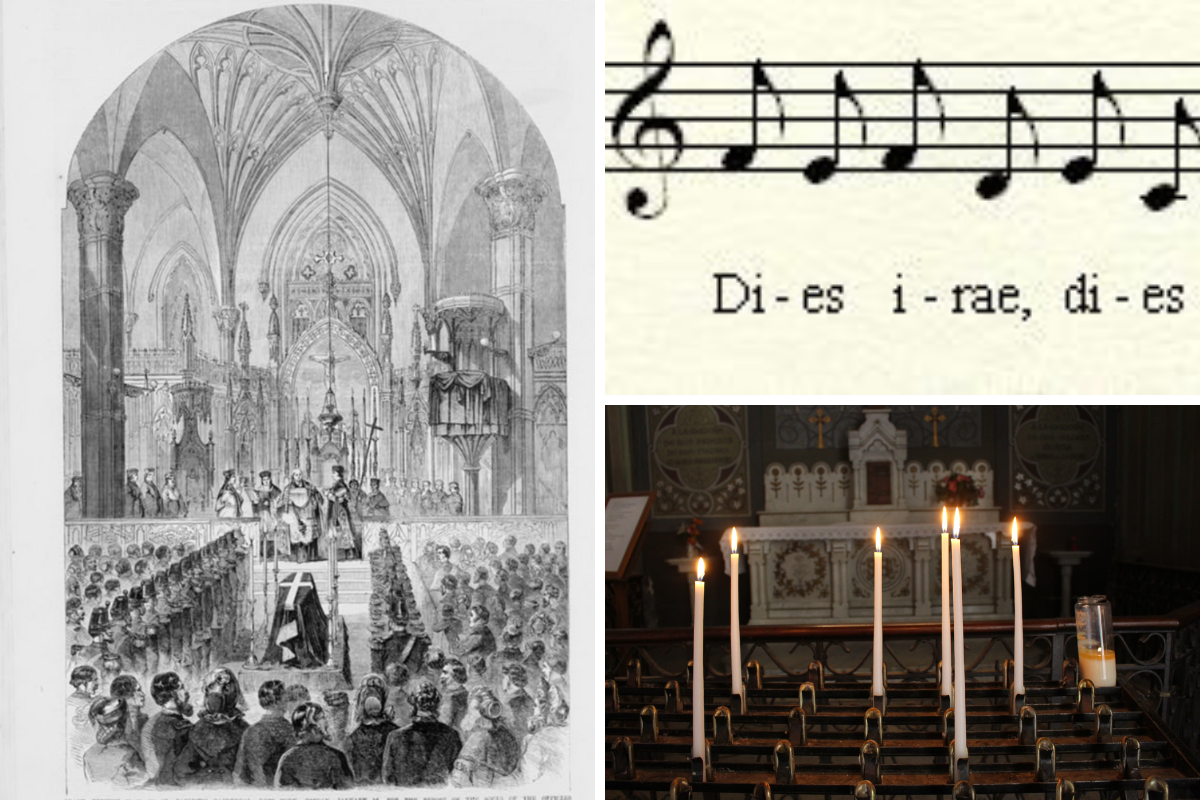
Ah, the requiem — so profound and inspirational, filled with drama and danger, but hopeful and confident that the Lord, who wants to save us, will snatch us from ruination if, in repentance, we ask it. Jesus has said, “No one who calls on me will I ever reject” (John 6:37).
There are surely dark notes in the requiem, for death is a serious matter. But, overall, it is biblically based prayers that the dead find rest through God’s mercy promised to Abraham and his descendants. Mary Magdalene and the thief on the cross are brought in as witnesses to the Lord’s mercy. But, above all, it is the Lord’s own astonishing love and sacrifice that forms the basis for hope and rest to all repentant believers.
Note too, that the old funeral Mass was called a requiem Mass — a “Mass of Rest.” This seems rather peaceful, poignant and more comforting than the modern terminology in the new Roman Missal, “Masses for the Dead.” Indeed, the opening words of the requiem Mass read (translated): “Rest eternal grant unto them, O Lord, and may perpetual light shine on them.” Yes, rest and unending light.
Even as the body is met at the door of the church, though less baptismal in focus than the new rite, there are these beautiful wishes:
“Come to his assistance, you saints of God; come forth to meet him, you angels of the Lord ... receiving his soul, offer it in the sight of the Most High. … May Christ receive thee who has called thee … and may the angels lead thee into Abraham’s bosom.”
The opening prayer also appeals to God’s mercy:
“O God, whose property is ever to have mercy and to spare, we humbly entreat You on behalf of the soul of Your servant whom You hast bidden to pass out of this world: that You would not deliver him into the hands of the enemy nor forget him forever, but command him to be taken up by the holy angels, and to be borne to our home in paradise, and that, as he had put his faith and hope in You, he may not undergo the pains of hell but may possess everlasting joys.”
Though, to many modern ears the very mention of hell is “dark,” the whole prayer is premised on God, whose nature is to show mercy and to spare souls.
The readings also surprised me. The epistle is from 1 Thessalonians 4: “Brethren, we would not have you ignorant concerning those who sleep, lest you be like the others who have no hope.” Then comes a great teaching on the day of resurrection as the reading concludes: “Therefore, console one another with these words.”
The Gospel, too, is of Jesus’ dialogue with Martha in John 11: “Your brother will rise. … I am the resurrection and the life; whoever believes in me, even if he dies, will live.” It’s beautiful and consoling, really.
As already referenced above, there is, of course, the Dies Irae, the sequence hymn between these two readings. I recall an older priest many years ago, when the subject came up, proclaiming exultantly: “Thank God we got rid of that dreadful thing.” It does truly begin on an ominous note:
Day of wrath and doom impending,
heaven and earth in ashes ending ...
Oh, what fear man’s bosom rendeth,
when from heaven the judge decendeth,
on whose sentence all dependeth.
Lo, the book exactly worded
Wherein all hath been recorded,
Thence shall judgment be awarded!
True, these are somber themes, but they are biblical, almost direct quotes. And they rightly describe the cosmic battle between good and evil and the drama of the salvation of souls. And, as sampled above, they have produced some of the most stirring and memorable moments of musical history. But note well: This same sequence hymn, with its opening dark syllables, contains some of the most hopeful and tender lines in all Christian writing:
Faint and weary thou hast sought me: On the cross of suffering bought me: Shall such grace be vainly brought me?
Through the sinful Mary shriven, Through the dying thief forgiven, Thou to me a hope has given
O loving Jesus Lord most blest, Grant to them eternal rest. Amen.
So beautiful! And such a wonderful case for mercy that is set forth! The earlier darker lines give way to the lightsome ones; and again, as discussed above, one of the most precious and musically celebrated lines, Pie Jesu, Domine! (“O Loving Jesus, Lord”), occurs in the very sequence hymn that begins Dies Irae (“Day of Wrath”). Taken as a whole, the Sequence for the Requiem is a well-balanced description of our sinful condition and of God’s mercy accessed through repentance.
I obviously cannot reproduce the whole requiem Mass here, but consider just a few other highlights of the hopeful and gentle themes that are struck in the prayers. Consider the Communion verse Lux Aeterna: “May light eternal shine on them, O Lord, with your saints forever. For you are kind (Quia pius es).
If there is “darkness” at all in the old requiem Mass, it is most likely because we have departed to a great degree in modern times from the notions that death is a serious matter and that, after we die, we are certainly judged. This judgment is a moment of honesty before God. The prayers of the older requiem give authentic acknowledgment of that and draw heavily on biblical themes. In the end, these prayerful reflections are always balanced with revealed truth that God is rich in mercy. One of the final prayers, at the commendation of the soul, shows this balance. Standing before the casket, the priest says:
“Enter not into judgment with Your servant, O Lord; for, unless You grant him forgiveness of all his sins, no man shall be justified in Your sight. Wherefore, we beseech You … sustain him by Your gracious favor, that he may escape Your retributive justice who, in his lifetime, was signed with the seal of the Holy Trinity.”
And never forget the beautiful In Paradisum:
“May the angels lead you to paradise and, at your arrival, may the martyrs receive you and lead you to the Holy City, Jerusalem.”
The Gregorian melody of this is so beautiful. And Fauré’s setting of this is so wonderfully peaceful, with the rhythm of a babbling brook.
For the record, many (though not all) of these prayers can be found in the current funeral Mass, but they are buried beneath a bevy of options and combinations. Surely, many of these options have their place. But the old requiem Mass was simple and well balanced between themes of judgment and appeals to God’s mercy. It was finely tuned that way.
Today, funerals, as commonly celebrated in parishes, tilt heavily to assured salvation, but with little or no reference to the repentance that brings God’s mercy. Most funerals are also heavily laden with eulogy and mention far too little of our need to pray for the dead who may need purgation. To this end, the traditional requiem gave a very clear statement of purpose in the Communion Antiphon:
“We offer unto Thee this sacrifice of prayer and praise. Receive it for those souls whom today we commemorate. Allow them, O Lord, to cross from death into the life which once Thou didst promise to Abraham and his seed.”
Hence, we are not simply “celebrating the life” of the departed, we are praying and offering sacrifice for them.
To be sure, in the current funeral rites, there is nothing to prevent the clergy from preaching more clearly on judgment and purgation, as well as heaven. I surely do, and I also issue a sober “come to Jesus” talk in the sermon to the attendees, since so many who are at funerals are not practicing their faith. In addition, black vestments can still be worn, as well as purple or white, and appropriate music be sung. Thus, balance can be had in the newer rites if the best options are selected and the clergy carefully oversee family “tributes” given before or during the Mass.
In the end, the “Requiem” was just that: a Mass of rest, resting in the arms of God’s mercy and beseeching it for our beloved dead. This November, remember the dead and pray for their happy repose.
Pie Jesu Dómine, Dona eis réquiem. (“Sweet Jesus, Lord, grant them rest”).
Amen.
- Keywords:
- prayers for the dead
- requiem mass


No comments:
Post a Comment
Please no anonymous comments. I require at least some way for people to address each other personally and courteously. Having some name or handle helps.
Note: Only a member of this blog may post a comment.